

The Garden Walk
A maintenance practice for complicated creative lives, for those with many hats

It’s a dead giveaway that I need a holiday when I find task-setting exhausting and onerous. It’s one of the parts of my job I think I appreciate the most! So it shouldn’t be awful sometimes. Like a lot of people in creative practice, I’m self-directed. I also wear many hats. I’m a writer, a researcher, a game developer, a board member, I’m a bitch, I’m a lover, I’m a child, I’m a mother etc etc. I have to work out what needs doing in any of these given realms before I can actually do any of it.
Deep down, I consider this a tremendous privilege. I can duck out for a coffee with my mum without having to run it by a boss or colleague. I can decide what kind of work my brain feels like doing that day and prioritise it accordingly. It’s a dignified way to work; one that doesn’t operate from the assumption that I’m a presumed delinquent who must be surveilled at all times lest I destroy shareholder value and bring an entire multinational to its knees by bunking off to do my laundry. I like working this way. I’m very lucky to work this way, it’s a luxury most people don’t have. And yet, in a dazzling display of ingratitude, I find myself occasionally envying people who can simply clock in and clock out.
I wanted to find a better way to organise my tasks so it felt as close as clock in clock out as I could get without engaging with hustle culture or the optimisation-maxxing weirdos out there hawking “ADHD-friendly” planners and notebooks. Naturally, I began by procrastinating doing the reading. Foucault’s “Technologies of the Self” gave me a new appreciation for the Stoics1 (didn’t see that coming, didya?) the Socratic practices of “taking care of oneself,” and epimeleia in general. His main claim is the practices we use to observe, discipline and transform ourselves are a kind of technology that we perform on our bodies, thoughts and conduct—alone or with others—in order to become the kind of person we want to become. He explains that the self is engineered. This idea of there not being some “true” inner self inside me was pretty revelatory, for reasons my therapist is probably best placed to explain.
Foucault said that Stoic examination was more concerned with remembering “what you’ve done and what you’ve had to do” rather than deciphering some secret self within us. That when creating technologies of the self we must look at the facts and the actions, and not get distracted by trying to decipher something about ourselves or our character while doing so. It made me realise that when I felt a pang of guilt about carrying an unfinished task over onto the next day, I was carrying an extraneous layer of analysis I absolutely didn’t need: “I did not advance the essay, therefore I’m a lazy unserious flake incapable of finishing anything.” Is that the truth? Probably not. “The essay hasn’t had much attention today.” Much better. As the youffs say, “Facts.”
I wanted to find a way to reframe my little task list away from a ‘productivity mindset’—riddled with unwelcome negative self-talk—to something with absolutely no room for my inner critic. I needed a way to decide what my work required without turning the condition of the work into a judgement on me, the worker. Ironically, a lot of “productivity” advice relies on some profoundly unproductive self-talk. A lot of it involves trying to squeeze the most juice out of every hour in the day, to the point where it’s convinced many of us there’s this mythical “12 hours” on the table at any given moment, we just needed to reach out and grab it. A lot of it ignores how difficult it can be to context switch between wildly different tasks. A to-do list can tell me that something was unfinished, but not what kind of attention it needed.
So I did something unforgivable, and a little embarrassing.
I accidentally invented a personal organisational method based on a visual metaphor. Then my imagination ran away with me and it got out of hand. I know how that sounds. Please don’t think less of me.
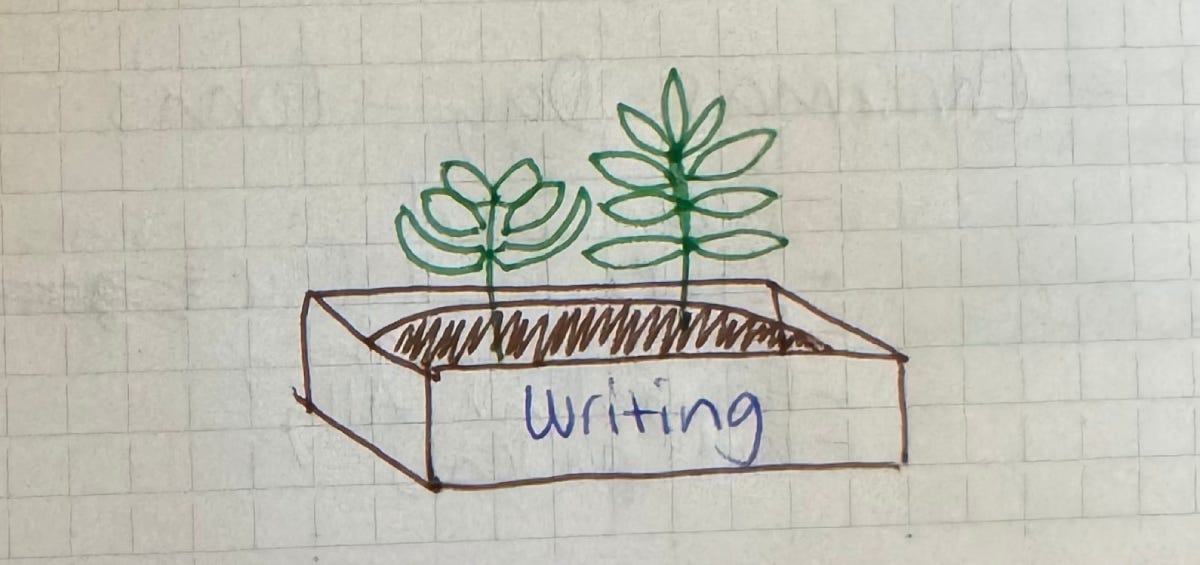
I started taking a weekly walk through the different parts of my work. Eventually, because I am insufferably incapable of leaving a metaphor unattended, it became a garden.
One garden bed was for my game dev work. One for each writing project. One for my volunteering work, one for home, one for planning our wedding. These are things that all need tending to. I don’t want to “complete” tasks, I want to cultivate something. I want to grow. Housework is never “completed” and finished, neither are most of my long-term projects, nor the important working relationships they rely on. I’m interested in the idea of reframing this work as stewardship. “What has been entrusted to my care and how do I tend to it well in my lifetime?”
Buoyed by the rush of thinking I was really onto something, I started running with it:
Tending to the soil of each bed is the preparatory work involved in making sure something good can grow there. For research and writing projects it’s reading, noticing, absorbing. Flirting with concepts and tracing my fingers around an idea.
An idea is a seed, sitting in its little packet until it’s time to commit to planting it. Once that decision’s been made—based on the season and the conditions of the soil—it involves new tasks like pitching, writing out a scene in a novel, establishing lines of inquiry, checking out networks and conferences or further research. Watering is showing up, following something up, check ins and emails and communicative work. Pruning is making hard but necessary cuts to benefit the project in the long run. Harvest is enjoying the fruits of your labour, completing the task, shipping, launching, presenting, publishing, invoicing, and reflecting. I’ve even managed to cram composting into this! She cannot be stopped! Composting is embracing the idea that much was learned besides the harvest. Rejected pitches can be tweaked and used again, or let go and used to create fertile soil for something new.
I told you this was getting out of hand.
But wait, there’s more.
Seasons! Not every garden bed is in bloom all year round. I need to bake-in periods of rest into creative projects or I get sick or uninspired. Again, this helps tackle the negative self-talk. Am I actually an unmotivated wretch or is this just a dormant time of year for that particular bed? If I figure out what needs harvesting when, I can work backwards and make sure the seeds are sown in the right season. Some of those harvests will be plentiful, some less so. Shit happens. Some seasons need less water.
Weeds! These tasks are urgent but of low value. They’re the renewable annoying things, always popping up but never the main event. Notifications, emails, tiny annoying admin tasks all pile up and take over the whole bed if you’re not careful. Or so I’m told. Is this a good time to mention I’m not a particularly gifted gardener? Or a particularly gifted metaphorist.
I got really in the weeds with stretching this metaphor as far as I could. The more astute reader will notice I did it again just now, almost as if I couldn’t help myself. I factored in storms (illness, caregiving responsibilities, things that take you away from the garden beds that you can’t control or stop). Burnout: an injury to the gardener from overwork! Storms hurt the garden beds whereas overwork injures the gardener themselves. Rest and vacation are THE BEES. The pollinators helping every garden bed!
You can see how I started to get a little nutty with this. I won’t even bore you with my Wider Theories on companion planting, crop rotation, germination and grafting. All this to say, it’s helped me and I’m risking the embarrassment of looking like an asshole by sharing this but I felt like this may be useful to people whose lives resemble mine.
To the practicalities! We can all breathe a sigh of relief, now.
I take two mental “walks” around my garden a week (usually Mondays and Fridays), checking out what’s growing and deciding where care is needed. From there a list of the day’s tasks can be estimated upon, sometimes I can plan out the whole week at once if I’m feeling saucy. The daily list is concerned with what can be done under today’s ‘weather’ conditions. Here’s an example of the weather conditions impacting a day I had last week, in case you thought you were out of the metaphor woods completely:
Poor sleep. Two meetings I wasn’t expecting. Two hours available writing time rather than the imaginary twelve I keep thinking I’m entitled to.
I don’t think this ideal version of myself I’d invented out of whole cloth is serving me particularly well, as a technology of the self. I was supposed to be ruthlessly disciplined and always getting up super early to get the most out of every day, and writing prolifically and smiling while eating yoghurt while wearing very expensive yoga pants, and never waking up with a slight hangover on a weekday. I don’t want to look at my task lists and think about what the ideal version of me would be doing, she sucks, we hate her. We’re never going to be her. I’d much rather be real and ask myself, “given what is true today, what’s the next useful move?”
If a Monday/early week garden walk is for creating the week’s task lists, then a Friday garden walk is more reflective. Instead of a catalogue of my failures or asking why I didn’t finish everything on my list I can ask more fruitful questions like: Did I water everything that needed watering? Is that plant drooping because it needs more water, or is there something bigger going on? Are any beds too crowded? Can something be composted to give the other plants room to breathe? That dinky little visual helps me organise all the strange and disparate tasks that make up a creative career without needing to simultaneously judge and psychoanalyse myself. A stalled essay is a stalled essay. It might be underprepared, obstructed, dormant, overgrown or no longer worth continuing. It doesn’t constitute a judgement on my character. A garden is a reflection of a whole bunch of conditions, not just me. It’s influenced by weather, soil conditions, seed quality, water access, and the expertise of the gardener. Sometimes the soil is just bung! Sometimes the seed was never going to grow because it was doomed from the start, no matter what you did.
A practical note if you’re thinking of giving it a go: it’s important to differentiate between a “task” and a “matter”. Tasks are the activities that tend to the “matter” that’s been planted. For example, “email the editor” is a task tending to the matter of “write XYZ article”. The plant here, the actual vegetable matter, is the article I want to write, and the watering and tending are all the steps needed to get to the harvest, which would be the publication of said article.
I keep all the beds in my planner, along with my daily tending tasks and the garden walk reflections. I have a rough version of time tracking to keep an eye on balancing my energy to harvest ratio, and I use the few blank pages at the back of my planner as my “seed bank”, a space to record new ideas or potential harvests.
Before we all get too excited and need to have a lie down, it’s important to flag that this approach has its limits, namely around relationships and social obligations. People are not plants. It would be ghoulish to have a garden bed for your marriage and use the visual to create little daily task lists that would feed and water the relationship long term. We never put a baddie in a spreadsheet. You’re a part of cultivating your relationships with people for sure, but you don’t ever “complete” them, they’re long term and can’t be ticked off a list. These things are more like the trees next to the garden, there you go. Trees! She cannot be stopped! Things like your personal relationships, parenting responsibilities, friendships, your reputation, your expertise, these are all slow-growing things that need your love and attention but they do not have a specific harvest, nor should they be treated like they do.
Not every responsibility is rightfully yours, either. Some problems require collective action to fix. Some parts of your life should be wild and unmanaged! A cute little visual can’t change material conditions. It doesn’t supply child care, or abolish exploitative work, or magic up extra hours in the week, and I’m not for one second claiming that the main thing standing between anyone and a manageable life is the absence of my little metaphor. It’s just a way to try and be kinder to yourself. To tend to your responsibilities without being an asshole to yourself the whole time. I’m writing it down partly so I can understand what I’ve made, and partly because I suspect some of you are also trying to maintain a small republic of unrelated obligations without appointing a tiny cop to supervise the whole thing.
Anyway, that’s the Garden Walk. I think I’m calling it that? I’m not good at naming things. It’s not a thing, even! I’m not trying to make it catch on or anything. It’s simply intended as a practical method for deciding what needs attention, and what does not, I think. A maintenance practice (or technology of the self!) for complicated creative lives. I think we all deserve the dignity of doing this work without the constant cruel commentary from the Statler and Waldorf inside our heads, and I hope it helps.
Lots of love, (she can’t be stopped!)
- Leena
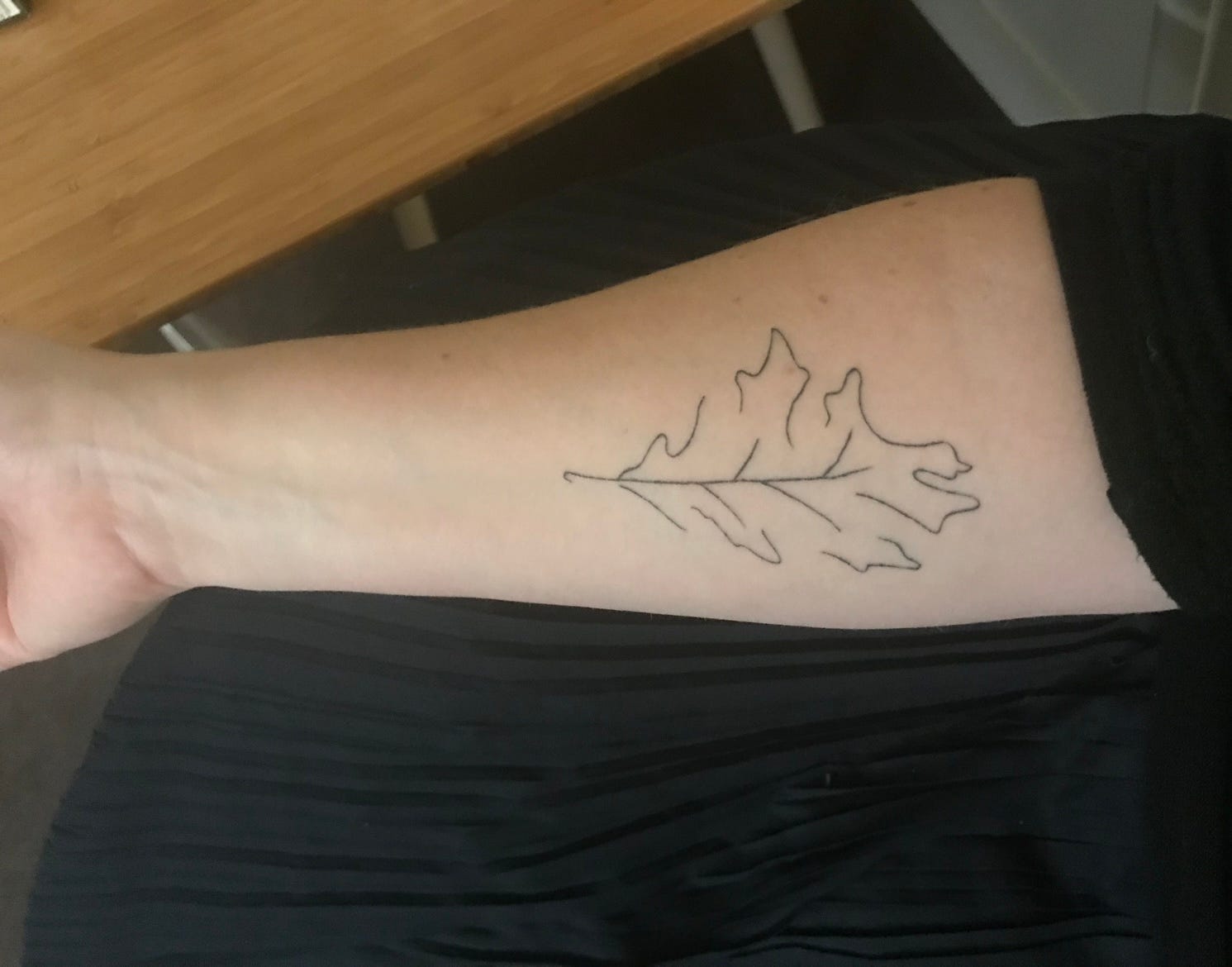
The Stoics say you must attend to the self, “retire into the self and stay there.”” The Epicureans believed that its never too late to occupy oneself with oneself. The jokes write themselves.